
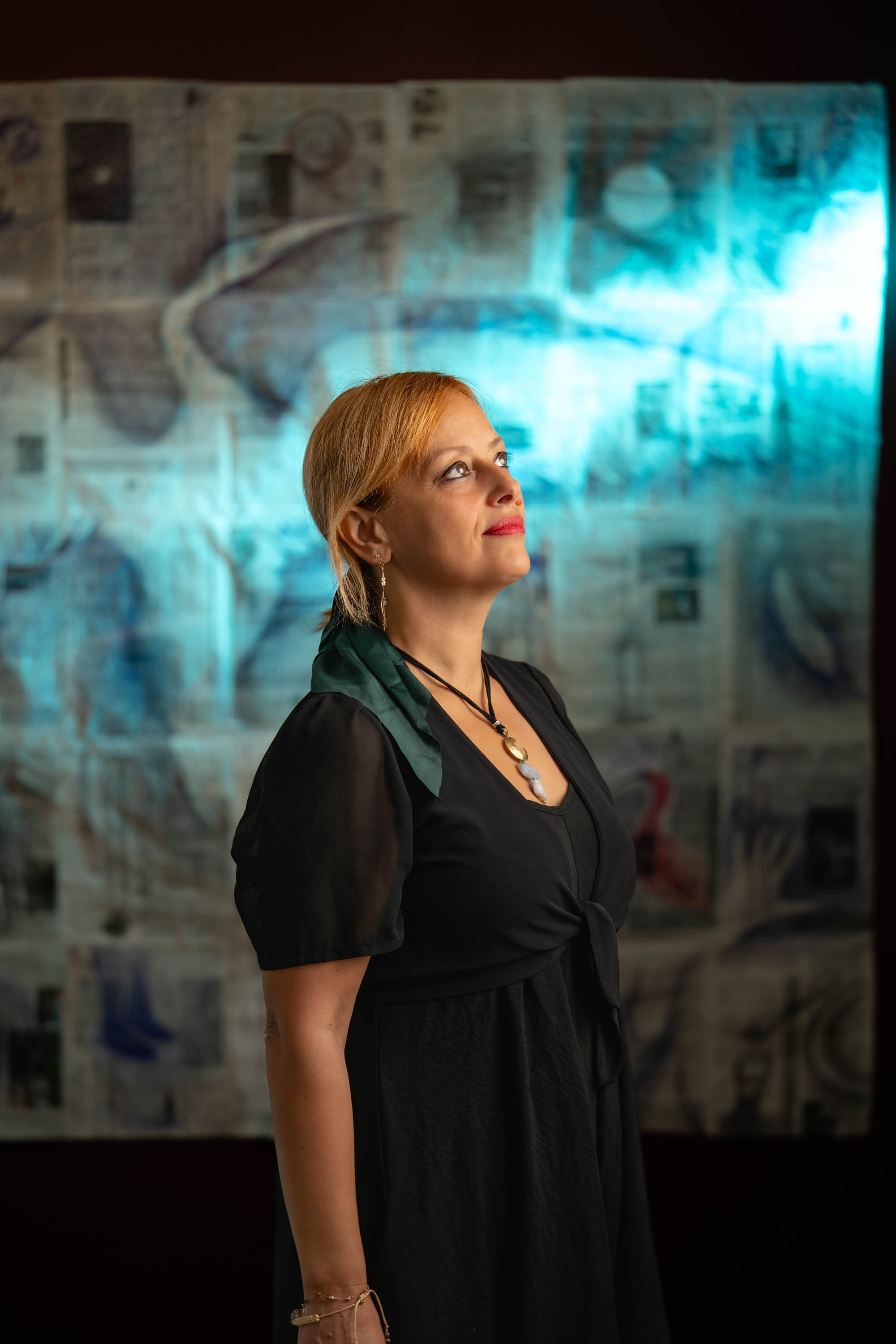
There are creative-minded people and then there are creators. The Italian artist Keziat is one of the latter. Kezia Terracciano, who graduated from the Academy of Fine Arts in Foggia, Italy in 1998, has created a completely distinctive visual language which permeates throughout her practice. First working in oil painting, Keziat made the shift to developing works of art using ballpoint pen in 2009 and, after exhibiting all over the world, has never looked back. This September, Keziat brought her unique artistry to Sarasota, for the American premiere of her exhibition Stelèa: Visions Beyond Time at 502 Gallery. The show, which features sketches, installations and video-performance work, is emblematic of everything Keziat represents as an artist. Keziat sat down with SRQ Magazine to discuss her exhibition, artistic progression and what drives her practice.
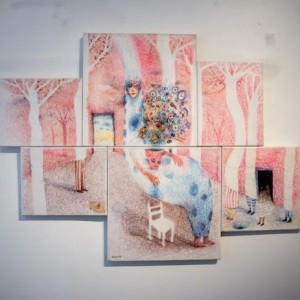
SRQ: Can you tell me about Stelèa and the different ideas that drove the creation of this show? KEZIAT Everything is exposed. The works are all made with just pen on canvas or paper, such as newspaper. I like to draw with a pen because it’s intuitive and instinctive. I use just normal pens—this one in my hand is a Bic—in blue, red and every color. I start with a small detail and continue on without making a sketch first, like a stream of consciousness. I never have a plan before starting my work. Stelea was created to move some emotions inside of me. It’s connected to my perception of the outside world. Everything that you see here are my emotions and memories—my mind is very imaginative. Many things have meaning for me—doors, small houses, the people without faces or heads. They symbolize the craziness of imagination that makes your head go up in the clouds. I’ll depict characters in flight, because my imagination is something that isn’t rooted to the ground.
Why do you use newspapers as the backdrop for some of your sketches? I like changing the reality of what is presented. Newspaper is the idea of the reality of what’s happening in the world and I like to change that with my artistic vision. Sometimes I leave the writing that has meaning for the drawing, but much of the time I like to cover everything with art, because the art can be just as powerful as reality. It shows the juxtaposition between reality and imagination. Before I draw on the newspaper, I’ll use some medium to fix the newspaper together. Oftentimes I’ll choose the particular pieces of newspaper because of the titles or the stories inside. Other times, it’s more just about the way that it looks or is chosen completely at random.
Is your artwork a way to process and channel emotions and things that you feel and memories? It absolutely is. There are many memories of mine that went into the making of this show. I have a need to be in contact with nature, and that’s something that comes out in the work in Stelèa. In some works, the motif of the bird with the eggs is about motherhood.
What does the title of this exhibition mean and why did you pick it? Stelèa is an imaginary name for stele. In Italy, the stele is a very old or ancient sculpture of a man or a woman. They are typically mystical stone reliefs, portraying gods or mythical figures. In many old works, there are imaginary symbols. I’ve researched some of those symbols of the ancient works and I see a connection between the symbols of the past and the symbols that appear in my work. Birds, the depictions of people as silhouettes, eyes and hands are all common throughout Stelea—I’ll feature the use of hands in my video performance works as well.
When people come in here and witness all of this, is there a particular story that you want to tell, or a way that you want people to feel? Every work tells a story. For example, there is a work titled Ho Raccolto dei Fiori Per Te or I Picked Some Flowers For You. Throughout the flowers, there are many eyes; in the work there are gaps in space, chairs without anybody sitting on them. It tells a story of solitude. Every detail is significant and works to tell a story. In Respiro Di Vento or The Breath of Wind, it was initially an installation with pieces of paper that were supposed to fly and move, hanging from the ceiling.
Has your practice evolved over time? Before I made the switch to using a pen, I painted a lot with oil. In 2009, I made the switch to pen—I wanted to be fast and intuitive. The use of pen felt more like myself. At first, I drew with only a black pen on small sheets of paper, before I started using colored pen on bigger and bigger canvases. I also started to incorporate video and installation into my practice. SRQ